B
How Office Acoustics Affect Productivity
The complaint arrives in every staff survey. People say the office is too noisy, that they can't concentrate, that they go home to finish the work they meant to do at their desk. Facilities teams respond by buying headphones, which treats the symptom and leaves the cause exactly where it was.
Sound is one of the few things in a workplace that nobody can opt out of. You can look away from a distracting view and you can ignore a badly placed printer, but the ear has no shutter, and a conversation happening eight metres away arrives whether you want it or not.
Why Speech Is The Hardest Sound To Ignore
Not all noise damages concentration equally. Steady mechanical sound, the hum of air conditioning or traffic behind a window, fades into the background within a few minutes because the brain stops treating it as new information. Speech behaves differently, and researchers have studied that difference for decades under the heading of the irrelevant speech effect.
The problem is meaning. When you can make out words, the language processing part of your brain engages with them automatically, and it does so whether or not the conversation has anything to do with you. That interference is strongest for tasks involving reading, writing, mental arithmetic or anything held in working memory, which describes most of what happens in an office.
Partially intelligible speech turns out to be worse than clear speech. A conversation you can almost follow keeps pulling attention back as the brain tries to fill in the gaps, which is why a colleague on a call two desks away is more disruptive than a full room of people talking at once.
The Real Cost Of An Interruption
The lost minute of the interruption itself is the smaller part of the problem. Work on attention and task switching has found that returning to full concentration after a significant interruption takes well over twenty minutes, and a busy open plan floor can deliver several of those before lunch.
Compound that across a team and the arithmetic gets uncomfortable. It shows up as work being taken home, as people arriving early to get an hour of quiet, as meeting rooms being booked by individuals who just want a door, and eventually in retention figures. Studies of workplace design and productivity have identified acoustic comfort as one of the strongest predictors of how satisfied people are with their office, ahead of things employers usually spend more money on.
Absorbing Sound
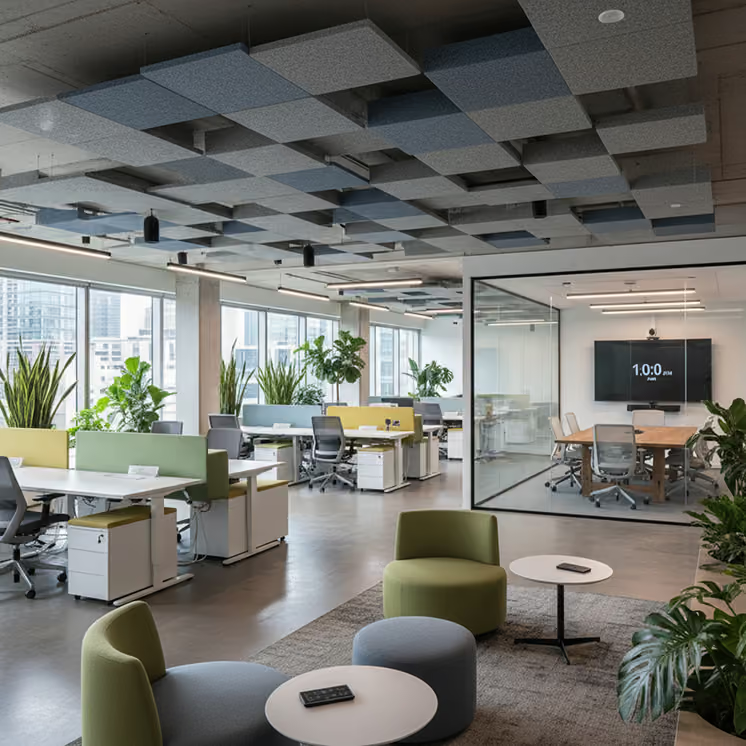
Most offices built in the last twenty years are acoustically hostile before anyone sits down. Exposed concrete soffits, glazed partitions, plasterboard walls and hard flooring reflect sound back into the room, so every conversation bounces around the floor plate and adds to the general level.
Absorption is the first fix and usually the cheapest. Acoustic ceiling rafts and baffles, wall panels, carpet or acoustic vinyl, and upholstered furniture all take energy out of the room and shorten the reverberation time. Aim to treat surfaces where sound arrives at an angle, which means ceilings above desk clusters and the walls facing each other across a narrow space.
Soft furnishings are doing genuine acoustic work, so the decision about whether to carpet a floor deserves more thought than it usually gets. Plants help a little, though considerably less than a well specified ceiling raft.
Blocking Sound
Blocking is about stopping sound getting from one space to another, and it's where fit-out detailing matters most. A partition that stops at the suspended ceiling and doesn't carry on up to the structural slab lets sound travel straight over the top, which is the single most common reason a meeting room doesn't feel private.
Doors are the next weak point. A solid core door with proper seals performs enormously better than a hollow one with a gap at the bottom, and no amount of wall specification compensates for the gap. Glass partitions can perform well acoustically if the glazing and junctions are specified for it, so you don't have to give up daylight to get quiet.
Layout does some of this work for free. Putting circulation routes, kitchens and print areas along one edge of the floor, with focus work at the other, separates the loud from the quiet without spending anything on materials.
Masking Sound
Sound masking adds a low level, carefully tuned background sound across a floor so that speech from further away drops below the threshold of intelligibility. It sounds counterintuitive, since you're introducing noise to solve a noise problem, but it works because it strips the meaning out of distant speech, and meaning is what pulls your attention.
Done well, people stop noticing it within a day and simply find that the conversation across the room no longer contains words they can follow. Done badly, with the level set too high or the spectrum wrong, it becomes another source of irritation. This is specialist work and worth commissioning properly.
Testing Before You Spend
Before committing to a specification, get someone to measure what you've actually got. Reverberation time, ambient sound levels at different times of day and speech transmission between spaces are all measurable, and the numbers often contradict the assumptions.
A survey will also tell you where to concentrate the budget. Treating the whole floor evenly is rarely the best use of money, and two or three targeted interventions in the right places usually produce a more noticeable change than a thin layer of treatment spread everywhere.
Fixing It In Your Building
Acoustic performance is far easier to design in than to retrofit, which makes it a conversation to have while the fit-out is still on paper. If you're already occupying the space, there's still plenty that can be done with ceiling treatment, screening and a reworked layout.
IMA Solutions delivers office fit-outs and installations for workplaces, healthcare settings and hospitality spaces, with our own design and install team. Give us a call with your floor plan and we'll walk through what your building is doing to your team's concentration.